


We’ve reduced it to two words on a button. “Buy Now.” “Sign Up.” “Learn More.”
The call to action (CTA) has become so synonymous with marketing that we’ve forgotten what it actually is: the moment when someone stands at the edge of transformation and asks another soul to leap with them.
Before It Was a Conversion Metric
Long before anyone measured click-through rates, calls to action were the hinge points of human experience. They’re the moment in every story when the hero stops planning and starts moving, when the theoretical becomes visceral, when “someday” collides with “now.”
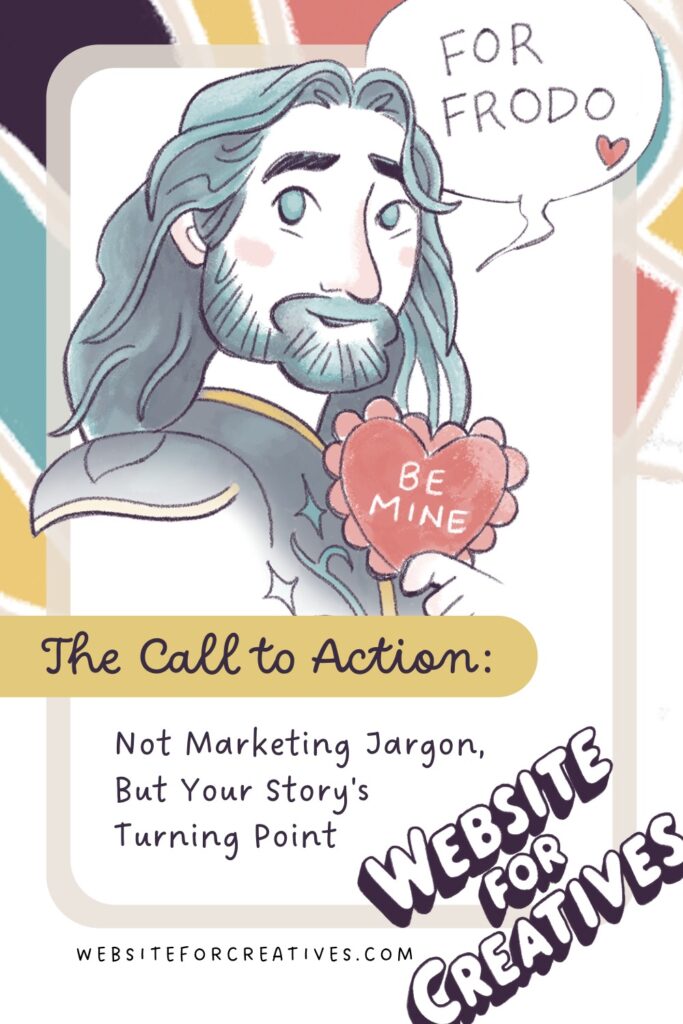
Think of Aragorn at the Black Gate, outnumbered beyond reason, turning to a fellowship of exhausted men and whispering, “For Frodo.” Not a strategy. Not a pitch. A call to action that says: I know you’re afraid. I’m afraid too. But this is the moment that will define us, and I need you with me.
That’s not marketing jargon. That’s the sound of someone willing to risk everything on the belief that others will follow.
The Anatomy of Real Calls to Action
Every genuine call to action, whether it’s rallying an army or asking someone to coffee, contains the same essential elements:
Vulnerability. You’re revealing what you want, which means revealing what you don’t yet have. When William Wallace rode before the Scottish army at Stirling, facing a superior English force, he didn’t hide behind bravado. He acknowledged the fear, the temptation to flee, the very real possibility of death. “They may take our lives, but they’ll never take our freedom!” The call to action was an admission: I cannot win this alone, but together we can become something greater than our fear.
Stakes. Something changes based on the response. When someone musters the courage to say “be mine” to their crush, they’re not making small talk. They’re standing on the precipice between two different futures. The answer matters. The moment matters. That’s what gives a call to action its power—the recognition that what happens next is not inevitable.

Invitation, not manipulation. A true call to action respects agency. It says, “Here’s where I’m going. Here’s why it matters to me. Will you come?” It doesn’t trick or coerce. The general giving a war cry before battle isn’t lying about the danger. The lover isn’t pretending they don’t need reciprocation. They’re offering a hand and hoping someone takes it.
Where We Lost the Thread
Somewhere along the way, we started treating calls to action as mechanisms rather than moments. We A/B tested them. We optimized them. We turned them into a formula: create urgency, minimize friction, manufacture scarcity.
And in doing so, we forgot that every call to action is, fundamentally, an act of hope.
When Frodo volunteers to take the Ring to Mordor, when a founder asks their first employee to join a company that doesn’t exist yet, when someone gets down on one knee—these are all the same motion. Someone is saying: I believe in something that doesn’t exist yet, and I’m asking you to believe in it with me.
That’s not a marketing tactic. That’s the courage of daring to create something bigger than yourself.
What This Means for Your Story
If you’re building something, creating something, trying to change something—you’re going to need to make a call to action. Not because some marketing playbook told you to, but because transformation doesn’t happen in isolation.
So ask yourself: What am I actually asking people to do? And more importantly, why does it matter?
Not “Why will this benefit them?” (though it should). Not “What pain point does this address?” (though it might). But why does this matter to you enough that you’re willing to risk rejection by asking?
Because that’s what makes a call to action resonate. Not the button color. Not the placement on the page. The willingness to stand up and say: “This is where I’m going. This is why I’m going there. I’d be honored if you came with me.”
The War Cry We All Carry
Every person who has ever done something worth remembering had to make a call to action. They had to turn to someone—a friend, a stranger, an army, a single person they loved—and say: Now. Here. With me.
Your calls to action might not echo through history. They might be as simple as asking someone to read what you’ve written, to try what you’ve built, to believe in what you’re attempting.
But they’re no less real. No less vulnerable. No less essential to your story.
So the next time you need to write a call to action, remember: You’re not crafting marketing copy. You’re standing at the edge of something that matters to you and asking if anyone else sees what you see.
That’s not jargon.
That’s courage.
What’s the call to action you’ve been too afraid to make?
Who are you waiting to ask?
What would you build if you knew someone would say yes?